The Therapeutic Community as Disciplinary Practice
One Flew Over the Cuckoo's NestThe Therapeutic Community as Disciplinary Practice is the ward’s model of treatment through social participation, disclosure, and rules, but the novel shows how easily that model becomes a means of discipline. Decisions presented as therapeutic can restrict privacy and movement, define protest as illness, and support coercive treatment. Its central contradiction is that patients are invited to participate in a community whose staff retain the power to set the terms, interpret dissent, and decide when a vote counts.
Principles and Promises
The model rests on Nurse Ratched’s claim that being in company is therapeutic while solitude deepens a patient’s separation. When patients ask why the dormitories cannot remain open after breakfast, she explains that their inability to adjust to society is why they are in the hospital. She also defends a requirement that at least eight men travel together to occupational or physical therapy, presenting enforced company as treatment rather than simply a restriction on movement. Her account makes ordinary preferences—sleeping late, being alone—potential symptoms to be corrected.
The same logic shapes the rules themselves. Nurse Ratched tells the ward that patients may have become ill because, perhaps since childhood, they were allowed to break social rules without receiving the punishment they needed. Discipline, in this explanation, is not an external penalty but a therapeutic necessity: the hospital must enforce order for the patients’ own good. The argument absorbs disagreement into its own rationale. Resistance can be read not as a reason to question the rule, but as proof that the patient requires correction.
Yet the system is not presented as nothing but overt force. Dr. Spivey and Randle Patrick McMurphy jointly propose converting the unused Tub Room into a second day room, partly to offer a quieter place for reading while others listen to the loud radio. Dr. Spivey frames the idea as a practical accommodation for patients of different ages and needs. Nurse Ratched objects that the ward lacks staff to supervise another room. The proposal shows that discussion can produce a patient-oriented change, but also that the staff’s control of resources can halt it before the group has a meaningful say.
Rules, Meetings, and Managed Participation
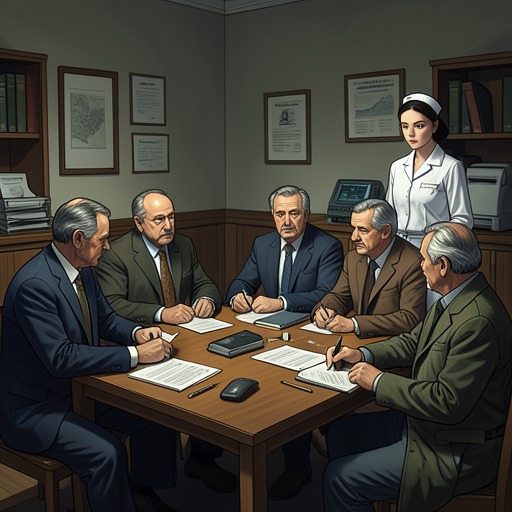
Group meetings give the community an appearance of collective deliberation, but the ward’s procedures limit what that participation can accomplish. Before the World Series, McMurphy proposes shifting chores to the evening so patients can watch the games during the day. Nurse Ratched refuses, citing the disruption a change would cause to the carefully arranged schedule. More striking to McMurphy is the other Acutes’ silence when he asks what they think. The meeting’s formal opportunity to speak does not itself give patients the confidence or freedom to do so.
When McMurphy raises the television question again, Nurse Ratched redirects the discussion from the proposed policy to whether he is imposing his own wishes on the group. She suggests he might be happier in another ward. The vote that follows demonstrates how procedure can defeat a visible majority: twenty patients support the change, but the ward has forty patients, and Nurse Ratched says a majority of all forty is required. She closes the vote as defeated. When McMurphy objects, she calls attention to his apparent upset and asks Dr. Spivey to note it. His anger becomes evidence about his condition, shifting attention away from whether the decision rule was fair.
That conversion of dissent into a clinical concern is part of a broader system of graduated threats. Fredrickson explains that a patient who is classified as potentially assaultive can be sent to the Disturbed Ward; he says this has happened to him three times and describes its patients as denied even a Saturday movie or a television. McMurphy’s challenge to the group’s silence is thus set against a known risk of losing privileges and being transferred. In the meeting, Dale Harding extends the warning to the Shock Shop and potentially an operation. The community’s invitation to speak is shadowed by consequences for speaking in the wrong way.
Coercion Behind Therapeutic Language
The treatment of Maxwell Taber makes the physical force behind the system unmistakable. When Taber questions his medication, Nurse Ratched grips his arm and tells him he can leave if he will not take it orally. Soon afterward, two aides seize him in the latrine and drag him to the mattress room. They hold him face down while the nurse prepares a long needle with Vaseline; she returns from the room wiping the needle and leaves Taber to be carried across the hall to the lab, his clothing torn and his body wrapped in a damp sheet. The sequence turns a refusal into a forced procedure, with the ward’s orderly routines concealing the violence from view.
The Shock Shop likewise appears as an institutional destination rather than a freely chosen treatment. Chief Bromden remembers a Friday, three weeks after the television vote, when patients who could walk are sent to Building One for chest X-rays. The line also passes a riveted, unmarked door. He sees patients given red capsules and dragged toward it, one stiffening his heels against the cement as technicians pull him toward the table. McMurphy asks whether electricity is sent through a person’s skull. His blunt question strips away the euphemism and links a concealed procedure to the ward’s power to impose it.
The treatment process continues to make compliance the stated measure of progress. After McMurphy is sent to the Disturbed Ward, Nurse Ratched and Dr. Spivey ask whether he is ready to face his problem and return to the ward for a cure. When he refuses, she authorizes another treatment. Chief Bromden describes three more treatments in one week, each following McMurphy’s recovery enough for him to answer defiantly. McMurphy turns his refusal into a performance for the other patients, bowing to them as they grin; Nurse Ratched then goes to the station to authorize the next treatment. His resistance briefly creates solidarity among witnesses, but it does not stop the staff from repeating the procedure.
Authority, Risk, and the Limits of Choice
McMurphy’s understanding of the ward changes when he learns that many of the patients who had let him challenge Nurse Ratched were not risking what he was. He had assumed their caution was cowardice; he discovers that they had not warned him that antagonizing her might lengthen his stay. Dale Harding explains that he is voluntary, while McMurphy is committed. He adds that only a few men on the ward are committed, including Scanlon and some Chronics. McMurphy’s startled questions make the distinction newly consequential: the same protest can carry different costs depending on who can leave and who cannot.
That realization complicates the apparent community among the patients. McMurphy tells Harding that he had learned why the others defer to Nurse Ratched and accuses them of using him while withholding the risk. He also admits the practical reason for changing his tactics: he does not want to provoke her into adding another year or so to his sentence. The ward’s rules therefore operate alongside unequal freedom to withdraw. A voluntary patient may choose to sign out; an involuntarily committed patient cannot treat that choice as an available safeguard.
The limits of patient power remain visible at the end of McMurphy’s struggle. Three weeks after he has been gone, Chief Bromden sees the ward door open and the aides wheel in a gurney marked with McMurphy’s name and the word Lobotomy. The chart makes the result legible as a completed medical intervention; the bruising and the motionless figure make its personal consequence visible to the patients. The episode does not erase the earlier moments of accommodation or collective action, but it establishes how decisively the institution can override them. The Therapeutic Community’s language of adjustment and cure can sustain genuine practical proposals, yet in the ward it also helps turn restrictions, punishment, and treatment imposed without effective patient consent into parts of a single therapeutic order.